Reading: Long vowels
Three main long vowels (ا - و - ي );
Lesson 6: More Prayer Words & Meet the Long Vowels!
In this lesson, we're going to learn ten new prayer words and meet a new family of letters: the long vowels! Get ready — these are going to unlock a whole new sound in your Arabic reading.
Big Discovery: Long Vowels!
So far, you've been learning about harakat — the little marks above and below letters that make short vowel sounds:
Fatha ( ـَ ) → short "a" (like the a in "cat")
Kasra ( ـِ ) → short "i" (like the i in "sit")
Damma ( ـُ ) → short "u" (like the u in "put")
But Arabic also has long vowels — vowels that you hold for twice as long! Think of harakat as a quick clap and long vowels as a long clap... clap .
Meet the Three Long Vowel Letters
Long vowels are made by combining a short vowel with a special letter — and they're letters you've already met!
Long VowelHow It's MadeSoundExampleLong āfatha + ا (alif)"aaa" (like father)بَا → "bā"Long īkasra + ي (ya)"eee" (like see)بِي → "bī"Long ūdamma + و (waw)"ooo" (like moon)بُو → "bū"
The Magic Rule:
When you see fatha followed by ا, you stretch the "a" sound! When you see kasra followed by ي, you stretch the "i" sound! When you see damma followed by و, you stretch the "u" sound!
A Fun Way to Remember
The three long vowel letters spell out a hidden word: ا و ي (alif, waw, ya). Some teachers call them the "stretching letters" because they stretch your vowels!
Listen to the difference:
بَ = "ba" (quick) → بَا = "bāāā" (long!)
بِ = "bi" (quick) → بِي = "bīīī" (long!)
بُ = "bu" (quick) → بُو = "būūū" (long!)
Try saying them out loud! Hold the long vowel for the count of two: "baaa" — one, two!
The Ten Prayer Words
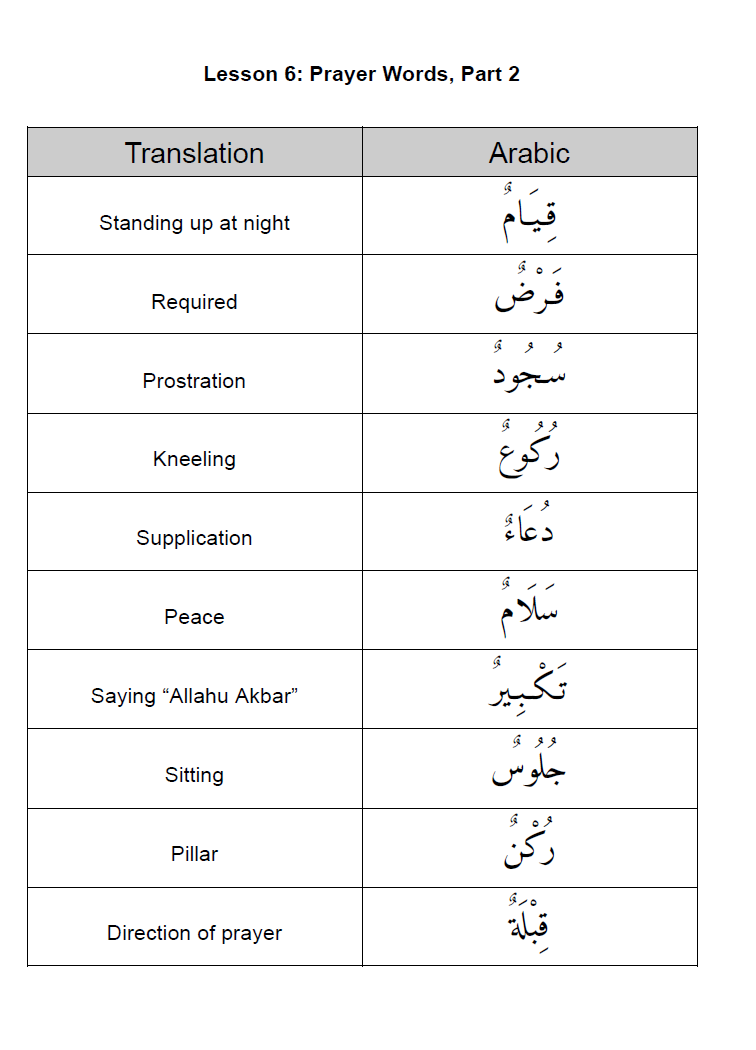
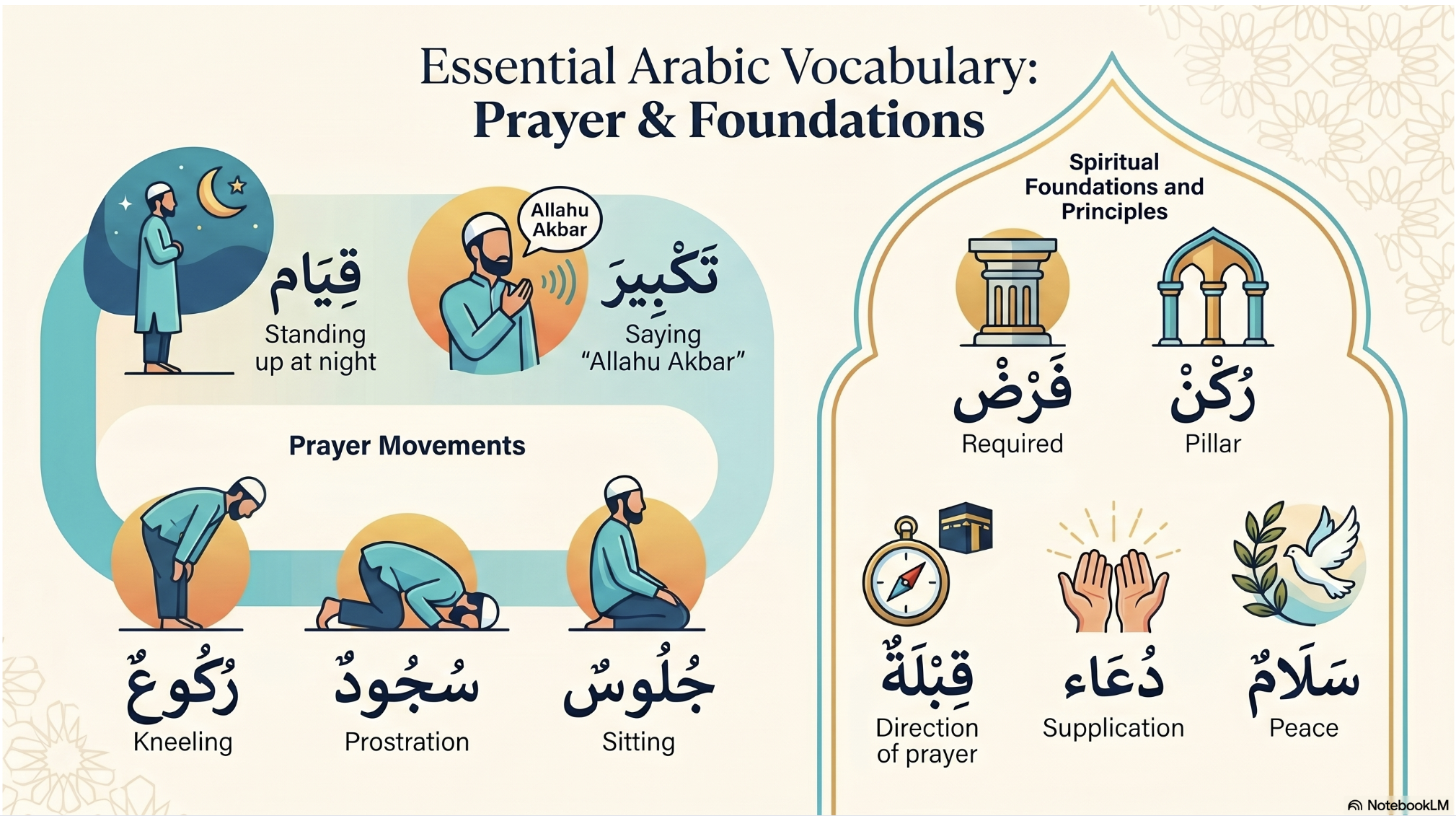
1. قِيَامٌ (qiyām) — "Standing up at night"
This word refers to standing in prayer at night, especially during the last part of the night.
Spot the long vowels: Look at يَا in the middle — that's a fatha followed by ا. Hold that "ā" sound!
Sound it out: "qi-yāām"
Letters: ق (qaf) → ي (ya) → ا (alif) → م (mim)
Memory tip: This word comes from the same root as قَامَ (qāma) meaning "he stood up." When you stand at night for extra prayers, you're doing qiyām!
2. فَرْضٌ (farḍ) — "Required / Obligatory"
This word means something that must be done in Islam — like the five daily prayers!
Spot the sukun: See the little circle on ر? That's a sukun! Say "far-ḍ" — not "fa-ra-ḍ."
Sound it out: "farḍ" (short and crisp!)
Letters: ف (fa) → ر (ra, with sukun) → ض (ḍad)
Memory tip: The five daily prayers are fard — they're required for every Muslim. The opposite is sunnah (recommended but not required).
3. سُجُودٌ (sujūd) — "Prostration"
This is when you put your forehead on the ground in prayer — one of the most beautiful positions in salah.
Spot the long vowel: Look at جُو — that's a damma followed by و! Hold that "ū" sound: "jūūū"
Sound it out: "su-jūūd"
Letters: س (sin) → ج (jim) → و (waw) → د (dal)
Memory tip: Sajda (one prostration) and sujūd (the act of prostrating) come from the same root. The Prophet ﷺ said the closest a person is to Allah is when they are in sujud!
4. رُكُوعٌ (rukūʿ) — "Kneeling / Bowing"
This is when you bow forward in prayer with your hands on your knees.
Spot the long vowel: كُو = damma + waw = long "ū"! Say "kūūū"
Sound it out: "ru-kūūʿ"
Letters: ر (ra) → ك (kaf) → و (waw) → ع (ayn)
Memory tip: In every rakʿah (unit) of prayer, you do one rukūʿ and two sujūd!
5. دُعَاءٌ (duʿā') — "Supplication / Calling on Allah"
This is when you make personal prayers and ask Allah for things from your heart.
Spot the long vowel: عَا = fatha + alif = long "ā"! Hold it: "ʿāā"
Watch out: That little symbol at the end (ء) is called hamza — a tiny "catch" in your throat.
Sound it out: "du-ʿā'"
Letters: د (dal) → ع (ayn) → ا (alif) → ء (hamza)
Memory tip: Duʿā is the "weapon of the believer" — you can make duʿā anytime, anywhere, in any language!
6. سَلَامٌ (salām) — "Peace"
A word every Muslim says many times a day! "Assalāmu ʿalaykum" means "peace be upon you."
Spot the long vowel: لَا = fatha + alif = long "ā"! Say "lāām"
Sound it out: "sa-lāām"
Letters: س (sin) → ل (lam) → ا (alif) → م (mim)
Memory tip: As-Salām is also one of Allah's beautiful names — "The Source of Peace"!
7. تَكْبِيرٌ (takbīr) — "Saying 'Allahu Akbar'"
This is the act of saying Allāhu akbar ("Allah is the Greatest") — said many times during prayer!
Spot two things: The sukun on ك AND the long vowel بِي (kasra + ya = long "ī")!
Sound it out: "tak-bīīr"
Letters: ت (ta) → ك (kaf, with sukun) → ب (ba) → ي (ya) → ر (ra)
Memory tip: Every time you start prayer, switch positions, or finish, you say Allāhu akbar — that act is called takbīr!
8. جُلُوسٌ (julūs) — "Sitting"
This is when you sit between the two prostrations, or at the end of the prayer.
Spot the long vowel: لُو = damma + waw = long "ū"! Say "lūūs"
Sound it out: "ju-lūūs"
Letters: ج (jim) → ل (lam) → و (waw) → س (sin)
Memory tip: Jalasa means "he sat down." When you do julūs in prayer, you're sitting calmly to remember Allah.
9. رُكْنٌ (rukn) — "Pillar"
A rukn is something essential — like a pillar holding up a building. Salah is one of the arkān (pillars) of Islam!
Spot the sukun: See it on ك? Say "rukn" — quick and strong!
Sound it out: "rukn"
Letters: ر (ra) → ك (kaf, with sukun) → ن (nun)
Memory tip: Islam has Five Pillars (arkān): shahada, salah, zakah, sawm, hajj. Each one is a rukn!
10. قِبْلَةٌ (qibla) — "Direction of prayer"
The qibla is the direction every Muslim faces when praying — toward the Kaʿba in Mecca!
Spot the sukun: See it on ب? Say "qib" — stop crisply!
Sound it out: "qib-la"
Letters: ق (qaf) → ب (ba, with sukun) → ل (lam) → ة (ta marbuta)
Memory tip: Wherever you are in the world, you face Mecca for prayer. There's even a compass called a qibla compass to help travelers find the right direction!
Long Vowel Spotting Game!
Look at these words from today's lesson and find the long vowels:
WordLong VowelTypeقِيَاميَاlong āسُجُودجُوlong ūرُكُوعكُوlong ūدُعَاءعَاlong āسَلَاملَاlong āتَكْبِيربِيlong īجُلُوسلُوlong ū
Did you notice? Most of our prayer words today have at least one long vowel — and many have an extra long sound right in the middle. That's because long vowels make words feel smooth and flowing — perfect for prayer language!
How to Tell Long Vowels Apart from Regular Letters
This can be tricky at first! Sometimes ا, و, and ي are letters that make their own consonant sound, and sometimes they're silent partners that just stretch the vowel before them.
Quick Test: Look at the harakat right before the letter:
It's a long vowel if:
ا comes after a fatha → بَا (bā)
و comes after a damma → بُو (bū)
ي comes after a kasra → بِي (bī)
It's just a regular letter (consonant) if:
و has its own harakat → وَ (wa) — like in wuḍū'
ي has its own harakat → يَ (ya) — like in qiyām (the first ي has fatha!)
Important: Look carefully at قِيَامٌ. The first ي has a fatha on it (it's pronounced "ya"), but the ا that follows it stretches the "a" — so we get "qi-yām." This is why reading Arabic carefully takes practice!
Writing Tips
The long vowel letters are easy to write — you already know them!
ا (alif) — a simple straight vertical line
و (waw) — looks like a tiny "9" or a circle with a tail
ي (ya) — a deep curve with two dots underneath (when at the end of a word)
Remember: ا and و are "loner" letters — they don't connect to the letter after them. So you'll often lift your pen when writing them!
Order of operations (this is important!):
Write all the letters and dots first
Add the harakat (short vowels)
Then add tanwin or sukun if needed
Practice: Long vs Short Vowels
Try saying these pairs out loud and feel the difference!
Short (quick)Long (stretch!)سَ "sa"سَا "sāā"لِ "li"لِي "līī"جُ "ju"جُو "jūū"
Now try a real word: سَلَام (salām)!
سَ = "sa" (short)
لَا = "lāā" (long!)
م = "m"
→ "sa-lāām"
Hear how the middle of the word stretches? That's the long vowel doing its job!
Learning Tip (For Parents and Teachers)
Long vowels (called ḥurūf al-madd or "letters of prolongation") are one of the most important concepts to introduce early in Arabic learning, because they affect almost every word in the Quran. Here are some teaching strategies:
Use clapping or counting to physically reinforce the difference: clap once for short vowels, clap twice (or hold a hand out for two beats) for long vowels. This builds an intuitive sense of vowel length that purely visual instruction can't provide.
Watch for the "homograph confusion" — Arabic learners often misread و and ي as consonants when they're functioning as long vowels (or vice versa). The "harakat test" above is the clearest rule, but it takes time to internalize. Be patient when students stumble on words like قِيَام where ي appears in both roles.
Connect to tajwīd early — long vowels are the foundation of madd rules in Quranic recitation. The basic madd ṭabīʿī (natural prolongation, held for 2 counts) is exactly what we're teaching here. Later, students will learn extended madd (4 or 6 counts) — but they all begin with the basic concept of stretching ا, و, and ي.
English speakers may need extra practice distinguishing short and long vowels because English uses vowel quality (different vowel sounds) rather than vowel length to differentiate words. In Arabic, the same vowel held for different lengths can mean entirely different words — kataba (he wrote) vs. kātaba (he corresponded with). Training the ear to hear duration is essential.
The "alif madda" (آ) — students may eventually encounter this special form, where alif carries a small wavy line above it (آ). It represents a hamza followed by a long ā, as in آدَم (Ādam). It can be introduced as a "shortcut" version of أَا.
Common pitfall: Students often forget that the long vowel letter itself is silent — it doesn't make its own consonant sound. The vowel before it does the work; the letter just extends it. Reinforce this by showing how سَا has only one syllable ("sā"), not two ("sa-a").
Writing: