Lesson 9: Reading Concept: Light & Heavy Letters
LESSON 9: Masjid Words & Review of the Heavy and Light Letters! NEW CONCEPT for this lesson is name of Allah
Today we're learning words you'll see all around the masjid — AND we're going to discover something super cool about Arabic letters: some are heavy and some are light! Once you learn this, your Arabic will sound much more authentic and beautiful.
The Big Idea: Heavy vs. Light Letters
Imagine you're holding two balloons:
A light balloon — feels airy, floats easily, sits high in your mouth
A heavy balloon — feels full, weighty, fills up your whole mouth
Arabic letters work the same way! Some letters are light (called muraqqaq / مُرَقَّق) and some are heavy (called mufakhkham / مُفَخَّم).
The Light Letters (Most Letters!)
Most Arabic letters are light. When you say them, your tongue stays relaxed and the sound feels "thin" and high in your mouth.
Examples: ب، ت، س، م، ن، د، ك، and most others!
The Heavy Letters (The Big 7!)
There are 7 special heavy letters in Arabic. When you say them, your tongue gets thick, the back of your mouth fills up, and the sound feels "full" and deep.
The seven heavy letters are: خ ص ض ط ظ غ ق
A fun way to remember them — they spell out the phrase: خُصَّ ضَغْطٍ قِظ (a memory aid teachers use, even though it's not a real word!)
Hear the Difference!
The best way to understand heavy and light is to compare letters that sound similar but feel totally different:
Light Heavy What's Different?س (sin)ص (ṣad)Same "s" sound, but ṣ fills the whole mouth!ت (ta)ط (ṭa)Same "t" sound, but ṭ is thick and bold!د (dal)ض (ḍad)Same "d" sound, but ḍ presses the tongue down!ذ (dhal)ظ (ẓa)Same "th" sound, but ẓ is full and deep!ك (kaf)ق (qaf)K is up front, Q is way back in the throat!
The Mouth Test!
Try this fun experiment:
Say "sa" (with س) → feel how light and breezy it is?
Now say "ṣa" (with ص) → feel your tongue get thick and your mouth feel full?
Trick to find heavy letters: When you say a heavy letter, the vowel after it sounds darker and deeper. The fatha "a" almost sounds like "aw," and the damma "u" sounds rounder and fuller!
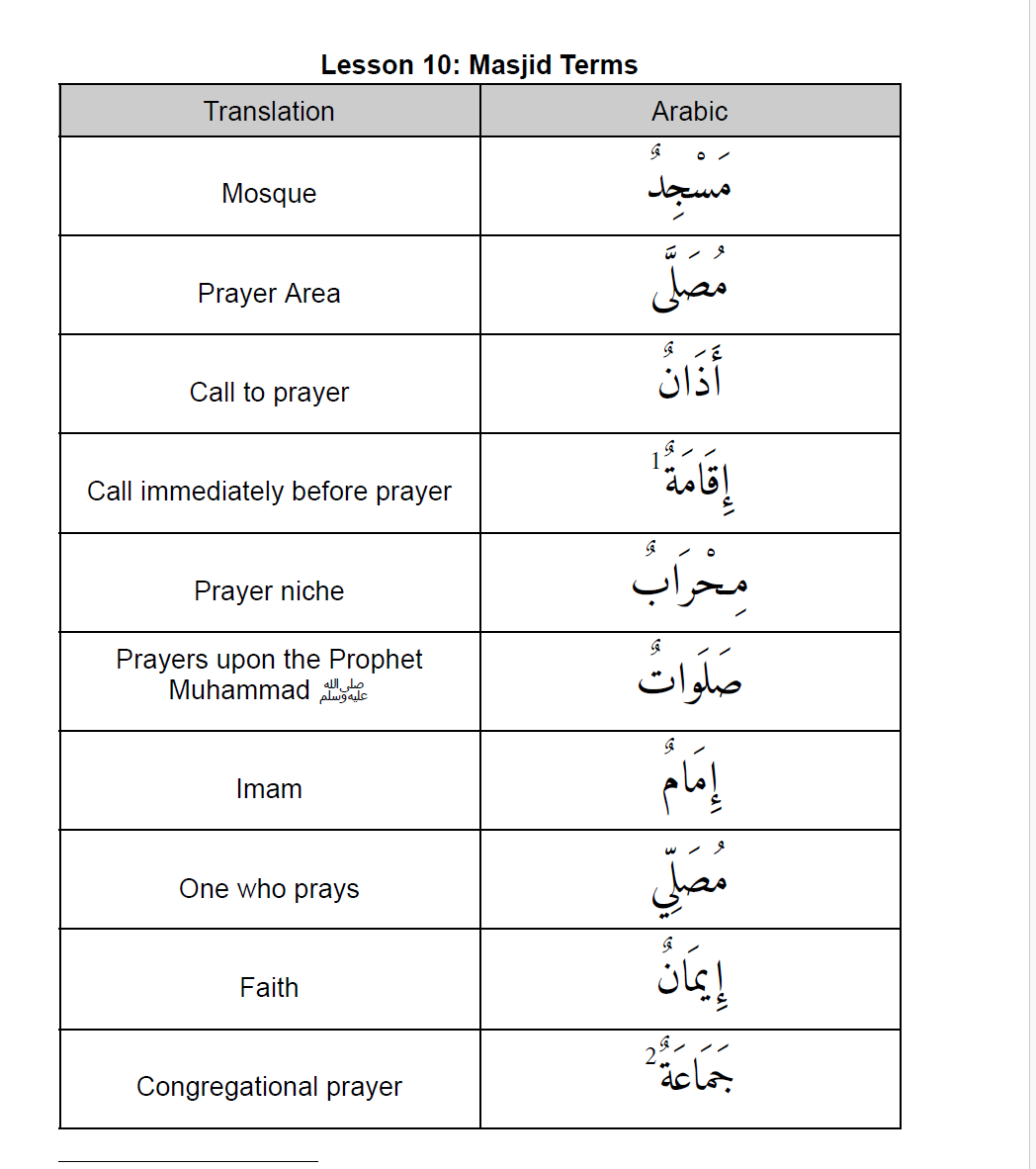
The Ten Masjid Words
Let's explore each word and spot the heavy and light letters!
1. مَسْجِدٌ (masjid) — "Mosque"
A masjid is the special place where Muslims gather to pray.
Light or heavy? All LIGHT letters! (م، س، ج، د)
Sound it out: "mas-jid" — say it lightly and crisply!
Spot the sukun: See it on س? Stop cleanly: "mas-jid"
Memory tip: Masjid literally means "place of prostration" — because it's where we do sujūd!
2. مُصَلَّى (muṣallā) — "Prayer Area"
This is a place set aside for prayer — sometimes inside a building, sometimes outside.
Light or heavy? Heavy! The ص is one of our heavy letters!
Sound it out: "mu-ṣal-lā"
Hear the difference: Compare masjid (light س) with muṣallā (heavy ص). The ṣ makes the whole word feel deeper!
Spot something new: See that little "w" mark ( ـّ ) on the ل? That's called shadda — it means we double the letter! We'll meet shadda properly soon. For now, just press on the "l" twice: "muṣal-lā"!
Memory tip: Muṣallā and muṣallī (which we'll see below) both come from the word ṣalāh (prayer)!
3. أَذَانٌ (adhān) — "Call to prayer"
This is the beautiful call you hear five times a day inviting Muslims to come pray.
Light or heavy? All LIGHT letters!
Sound it out: "a-dhāān"
Spot the long vowel: ذَا = fatha + alif = long ā! Hold it: "dhāān"
Memory tip: The first person to call the adhān was Bilāl ibn Rabāh (RA) — the Prophet's ﷺ companion known for his beautiful voice!
4. إِقَامَةٌ (iqāma) — "Call right before prayer"
This is a shorter call given right before the prayer starts, telling everyone to line up.
Light or heavy? Heavy! The ق is one of our heavy letters!
Sound it out: "i-qāā-ma"
Feel the heaviness: Notice how iqāma sounds deeper than adhān? That's because of the heavy ق! Try saying both back-to-back and feel the difference.
Long vowel alert: قَا = fatha + alif = long ā!
5. مِحْرَابٌ (miḥrāb) — "Prayer niche"
The miḥrāb is the curved alcove in the front wall of a masjid that shows the qibla direction.
Light or heavy? Mostly light, but pay attention to ر!
Spot the special letter: ر (ra) is a tricky letter — it can be either heavy OR light depending on the vowel! With fatha or damma, ra is heavy . With kasra, ra is light . In miḥrāb, ra has fatha → so it's heavy!
Sound it out: "miḥ-rāāb" (with that deep, rolling r!)
Long vowel alert: رَا = fatha + alif = long ā!
6. صَلَوَاتٌ (ṣalawāt) — "Prayers upon the Prophet ﷺ"
This means sending blessings on the Prophet Muhammad ﷺ — like saying "Allāhumma ṣalli ʿalā Muḥammad."
Light or heavy? Heavy! The ص is one of our heavy letters, and it's right at the start!
Sound it out: "ṣa-la-wāāt"
Long vowel alert: وَا = fatha + alif = long ā!
Memory tip: Every time we hear the Prophet's ﷺ name, we send ṣalawāt on him — that's why you see ﷺ written after his name!
7. إِمَامٌ (imām) — "Imam (prayer leader)"
The imām is the person who stands in front and leads the prayer.
Light or heavy? All LIGHT letters!
Sound it out: "i-māām"
Long vowel alert: مَا = fatha + alif = long ā!
Memory tip: The word imām comes from amām (in front) — because the imam stands in front of everyone!
8. مُصَلِّي (muṣallī) — "One who prays"
This word describes a person who is praying or who prays regularly.
Light or heavy? Heavy! The ص again!
Sound it out: "mu-ṣal-lī"
Spot the shadda: Same as muṣallā — there's that little "w" on ل, so we double it: "muṣal-lī"
Long vowel alert: لِي = kasra + ya = long ī!
Compare: muṣallā = the place of prayer. muṣallī = the person who prays!
9. إِيمَانٌ (īmān) — "Faith"
This is one of the most important words in Islam — īmān means belief and faith in your heart.
Light or heavy? All LIGHT letters!
Sound it out: "īī-māān"
Two long vowels! إِي = kasra + ya = long ī, AND مَا = fatha + alif = long ā!
Memory tip: A mu'min (believing person) is someone who has īmān in their heart!
10. جَمَاعَةٌ (jamāʿa) — "Congregational prayer"
This is when Muslims pray together as a group.
Light or heavy? All LIGHT letters! (Though ع is a "throat letter" — special, but not heavy.)
Sound it out: "ja-māā-ʿa"
Long vowel alert: مَا = fatha + alif = long ā!
Memory tip: Praying in jamāʿa is 27 times more rewarding than praying alone — that's why Muslims try to come to the masjid for prayer!
Heavy vs. Light Spotting Game!
Look at our masjid words and see which contain heavy letters:
Words with HEAVY letters:
مُصَلَّى (muṣallā) — has ص
إِقَامَة (iqāma) — has ق
مِحْرَاب (miḥrāb) — has heavy ر
صَلَوَات (ṣalawāt) — has ص
مُصَلِّي (muṣallī) — has ص
Words with ALL LIGHT letters:
مَسْجِد (masjid)
أَذَان (adhān)
إِمَام (imām)
إِيمَان (īmān)
جَمَاعَة (jamāʿa)
Try this: Read each word out loud. Can you hear how the heavy ones sound fuller and deeper than the light ones?
Best Comparison: مَسْجِد vs. مُصَلَّى
These two words are PERFECT for hearing the difference!
WordKey LetterFeelمَسْجِد (masjid)س — light "s" thin, highمُصَلَّى (muṣallā)ص — heavy "ṣ" thick, full
Put your hand on your throat or jaw and say each one slowly. With ص, you should feel:
Your tongue press down and back
Your mouth feel rounder
The vowels sound deeper ("ṣaa" almost like "ṣaw")
Special Rule: The Lām of Allah!
Now for something really special — and only for the most important word in our vocabulary!
The Word "Allāh" (اللَّه)
You know that ل (lam) is normally a light letter, right? It's thin and crisp, like in imām or jamāʿa.
BUT — there's one special exception! In the name اللَّه (Allāh), the lām is sometimes pronounced HEAVY!
This is called the lām of jalālah (لَام الجَلَالَة) — "the lām of majesty."
The Two Cases:
Rule 1: Heavy Lām — when "Allāh" is preceded by a fatha ( ـَ ) or damma ( ـُ ).
Examples:
نَصْرُ اللَّه (naṣru llāh) — "the help of Allah" — u before, so HEAVY ل!
قَالَ اللَّه (qāla llāh) — "Allah said" — a before, so HEAVY ل!
وَاللَّه (wallāh) — "By Allah!" — a before, so HEAVY ل!
عَبْدُ اللَّه (ʿabdu llāh) — "servant of Allah" — u before, so HEAVY ل!
When you say it, the "l" sounds full and deep — almost like the whole mouth fills up to honor Allah's name!
Rule 2: Light Lām — when "Allāh" is preceded by a kasra ( ـِ ).
Examples:
بِسْمِ اللَّه (bismi llāh) — "In the name of Allah" — i before, so LIGHT ل!
لِلَّه (li-llāh) — "for Allah" — i before, so LIGHT ل!
ٱلْحَمْدُ لِلَّه (al-ḥamdu li-llāh) — "All praise is for Allah" — i before, so LIGHT ل!
Here, the "l" stays thin and gentle.
The Easy Memory Trick:
"i" makes it light, "a" and "u" make it heavy!"
Or even shorter:
i before → light
a or u before → heavy
Try It Yourself!
Compare these two phrases out loud:
"Bismi llāh" (بِسْمِ اللَّه) — kasra before, so the lām is light: "bis-mil-LAAH" (gentle)
"Naṣru llāh" (نَصْرُ اللَّه) — damma before, so the lām is HEAVY: "naṣ-rul-LAAH" (deep and full)
Can you hear the difference? In the second one, the L feels rounder and more powerful — like your mouth is honoring the name of Allah!
Practice Game: The Light/Heavy Detective!
Read these phrases and decide: is the lām of Allāh light or heavy ?
عَبْدُ اللَّه (ʿAbdullāh) — "servant of Allah"
بِسْمِ اللَّه (Bismillāh) — "In the name of Allah"
مَا شَاءَ اللَّه (Mā shā'allāh) — "What Allah willed"
سُبْحَانَ اللَّه (Subḥānallāh) — "Glory be to Allah"
إِنْ شَاءَ اللَّه (In shā'allāh) — "If Allah wills"
<br>
Answers:
عَبْدُ اللَّه → damma before → HEAVY
بِسْمِ اللَّه → kasra before → LIGHT
مَا شَاءَ اللَّه → fatha before → HEAVY
سُبْحَانَ اللَّه → fatha before → HEAVY
إِنْ شَاءَ اللَّه → fatha before → HEAVY
How many did you get right?
Quick Practice
Try saying each of these out loud, paying attention to whether the letters feel heavy or light:
Light words: masjid, adhān, imām, īmān, jamāʿa
Heavy words: muṣallā, iqāma, ṣalawāt, muṣallī
Mixed phrases with the lām of Allāh:
Al-ḥamdu li-llāh (light) — "all praise is for Allah"
Subḥāna llāh (heavy) — "glory be to Allah"
Learning Tip (For Parents and Teachers)
Heavy and light letters (tafkhīm and tarqīq) are essential to authentic Arabic pronunciation, especially for Quranic recitation. Here's how to teach this concept effectively:
Start with feel, not theory — before naming the letters or rules, have students feel the difference. Place a hand on the jaw or throat while saying س vs. ص. Heavy letters (called ḥurūf al-istiʿlā — "letters of elevation") cause the back of the tongue to rise toward the soft palate, which students can physically sense.
The 7 heavy letters are remembered through the mnemonic خُصَّ ضَغْطٍ قِظ (khuṣṣa ḍaghṭin qiẓ). Each letter of this phrase represents one heavy letter: خ ص ض غ ط ق ظ. While the phrase isn't a real word, it's the standard memory aid in tajwīd instruction worldwide.
The conditional letters ر and ل deserve special attention because they switch between heavy and light depending on context. For beginners, introduce only the basic rules (ر is heavy with fatha/damma, light with kasra; ل is normally light except in Allāh after fatha/damma). The full ر rules involve sukun and adjacent letters and can come later.
Watch for "flat" English-influenced pronunciation — English speakers tend to pronounce all Arabic letters at the same neutral mouth position. Without explicit training in heavy/light contrast, learners say ṣalāh with a light س sound, which fundamentally changes the word. Consistent pair-practice (س/ص, ت/ط, د/ض, ذ/ظ) corrects this early.
The lām of jalālah (the special rule for "Allāh") is one of the first tajwīd rules taught traditionally because it appears so frequently in Quran and daily speech. Mastering this single rule dramatically improves the sound of a learner's recitation. The rule itself is simple — fatha or damma before → heavy; kasra before → light — and students can apply it immediately in Bismillāh, Alḥamdulillāh, Subḥānallāh, etc.
Why does kasra make ل light? From a phonetic standpoint, kasra (the "i" sound) is produced with the tongue raised toward the front/hard palate, which is incompatible with the back-tongue elevation of tafkhīm. So the kasra naturally "pulls" the lām into a light pronunciation. The fatha and damma don't have this conflict, so the heavy pronunciation can be maintained.
The "rāʾ" rules that govern when ر is heavy or light are more complex than ل (involving sukun, adjacent letters, and even imāla — the slight "e" sound in some dialects). For beginners, it's enough to teach: "ر with fatha or damma is heavy; ر with kasra is light." More nuanced cases (like ر with sukun followed by certain letters) can be introduced when students start formal tajwīd study.
Use Quranic recitation early — once students understand the basic concept of heavy/light, even short surahs like Al-Fātihah become a rich training ground. Al-ḥamdu lillāh (light lām after kasra), rabbi l-ʿālamīn (light ر in rabbiwith kasra, heavy ر in ʿālamīn with kasra... wait, that's heavy because of context), aṣ-ṣirāṭa l-mustaqīm (heavy ص and ط back-to-back!) — students can hear these rules in action with every recitation.
Audio is irreplaceable — there's no substitute for hearing skilled reciters apply these rules. Recommend recordings by reciters like Al-Husary, Mahmoud Khalil Al-Hussary, Mishary Alafasy, or Abdul Basit Abdul Samad, whose pronunciation is clear and pedagogically excellent. Even 5 minutes of daily listening accelerates internalization remarkably.