Reading Concept:
Sukoon: Explain what sukoon is and how to identify it.
Lesson 5: Meet the Sukun!
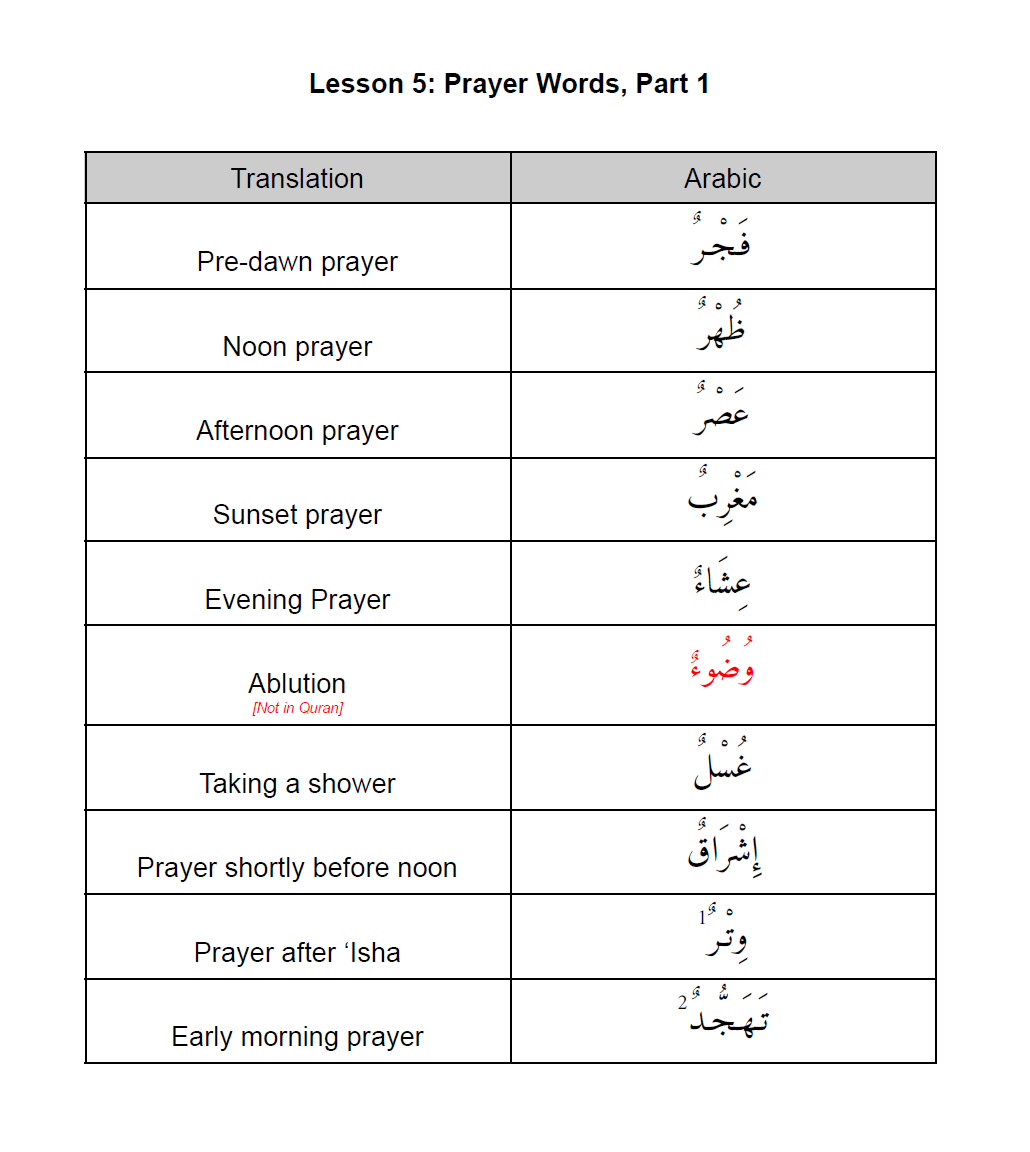
Look at the words in our prayer vocabulary chart. Do you see those tiny circles ( ـْ ) sitting on top of some letters? Those little circles are called sukun — and they're about to become your new best friend!
What Is Sukun?
Sukun ( ـْ ) is a small circle that sits on top of a letter. Its name in Arabic literally means "stillness" or "silence."
Here's the simple idea:
A letter with a harakat (fatha, kasra, or damma) MOVES — it makes a vowel sound. A letter with a sukun is STILL — no vowel sound, just the consonant.
That's it! Sukun is like a little stop sign. When you see it, you say just the letter's basic sound — no "a," no "i," no "u" attached.
A Fun Way to Think About It
Imagine each Arabic letter is like a person:
A letter with fatha ( ـَ ) is walking → "ba"
A letter with kasra ( ـِ ) is walking → "bi"
A letter with damma ( ـُ ) is walking → "bu"
A letter with sukun ( ـْ ) is standing still → just "b"!
The sukun's tiny circle even looks like a little stop sign or a pause button!
Hear the Difference
Let's compare a letter with a vowel vs. a letter with sukun:
With Vowel (moving)With Sukun (still)بَ → "ba"بْ → just "b"كَ → "ka"كْ → just "k"سَ → "sa"سْ → just "s"مِ → "mi"مْ → just "m"
Try saying both versions out loud. Can you feel how your mouth stops with the sukun version, but opens up with the vowel version?
Sukun in Our Prayer Words
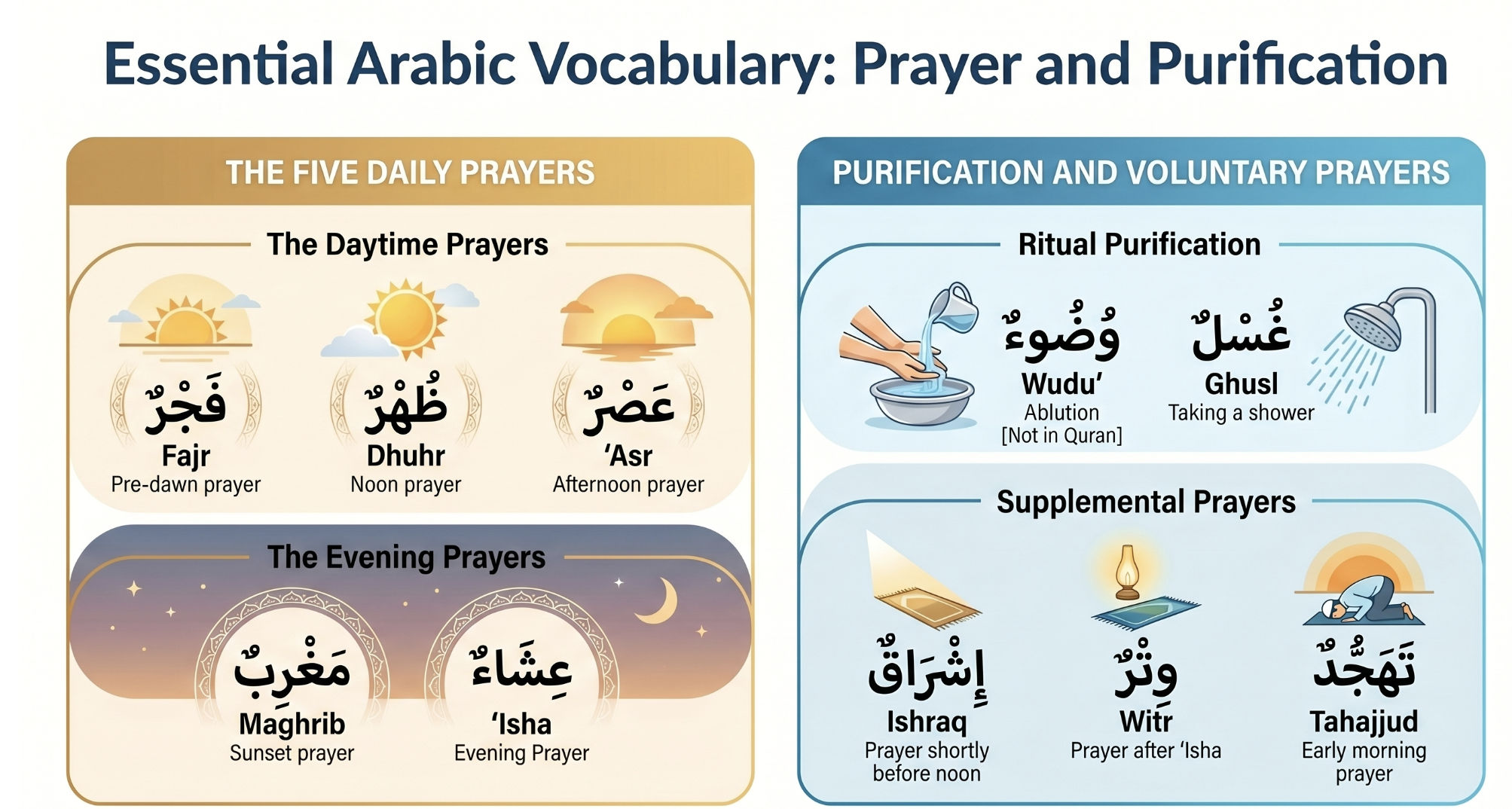
Let's look at our prayer vocabulary and spot the sukuns!
فَجْرٌ (fajr) — Pre-dawn prayer
Look at the ج in the middle. See the tiny circle? That's a sukun!
Without sukun, we might say: "fa-ja-r" With sukun, we say: "faj-r" — the j is "stuck" right onto the f, with no vowel between them!
Sound it out: f ... aj ... r
ظُهْرٌ (ẓuhr) — Noon prayer
The ه has a sukun on top.
We don't say "ẓu-ha-r." We say "ẓuhr" — the h is silent of vowels and connects straight to the r.
عَصْرٌ (ʿaṣr) — Afternoon prayer
The ص has a sukun. So we say "ʿaṣr" — not "ʿa-ṣa-r."
مَغْرِبٌ (maghrib) — Sunset prayer
Spot the sukun on غ! We say "magh-rib" — the gh has no vowel after it.
إِشْرَاقٌ (ishrāq) — Mid-morning prayer
The ش has a sukun. Say it: "ish-rāq."
وِتْرٌ (witr) — Prayer after Isha
The ت has a sukun. Say it: "witr" — short and crisp!
غُسْلٌ (ghusl) — Taking a shower (ritual bath)
The س has a sukun. Say it: "ghusl."
Where Does Sukun Usually Appear?
Sukun loves to show up in two main spots:
1. In the MIDDLE of a word, between two vowels.
فَجْرٌ (faj-r) — sukun in the middle
مَغْرِبٌ (magh-rib) — sukun in the middle
2. At the END of a word, when we stop on a letter.
لَمْ (lam) — "not"
قُلْ (qul) — "say!"
مِنْ (min) — "from"
You'll spot sukun everywhere in the Quran and in everyday Arabic!
How to Write Sukun
Writing sukun is super easy:
Step 1: Write your letter normally with all its dots. Step 2: Above the letter, draw a tiny circle — just like a tiny "o" or a small donut. Step 3: Keep it small! It should be about the size of a dot, not a big balloon.
Tip: Some people draw the sukun more like a little oval or a small "0" shape. As long as it's clearly a closed circle (not a curl like damma!), you're good.
Don't Mix Up Sukun and Damma!
This is a common mix-up for beginners. Look carefully:
MarkLooks LikeSoundDamma ـُa tiny curl with a tail (like a comma)"u"Sukun ـْa tiny closed circle (like an "o")no sound
Easy memory trick:
Damma has a tail → it's "moving" → makes a sound
Sukun is a closed circle → it's "stuck" → makes no sound
If the mark has a tail, it talks. If it's a closed circle, it's silent!
A Helpful Pattern: The Sukun Sandwich
In words like فَجْر and عَصْر, you'll notice something cool:
The first letter has a vowel (fatha)
The middle letter has a sukun
The last letter has a vowel (or tanwin)
This makes a "sandwich" with the sukun in the middle! It creates that crisp, clipped sound you hear in many Arabic prayer names.
Sound out these sandwiches:
فَ + جْ + رٌ = "faj-run"
ظُ + هْ + رٌ = "ẓuh-run"
عَ + صْ + رٌ = "ʿaṣ-run"
مَ + غْ + رِبٌ = "magh-rib-un"
وِ + تْ + رٌ = "wit-run"
Once you spot this pattern, you'll see it all over Arabic!
Practice Game: Stop and Go!
Pick any Arabic word with sukun and try this:
Green light (vowel): Say the letter's sound with its vowel — keep going! Red light (sukun): Stop the letter cleanly — no vowel!
Try with فَجْر:
ف with fatha → "fa" (go!)
ج with sukun → "j" (stop!)
ر with damma → "ru" (go!)
Put it together: "faj-ru"
Practice this stop-and-go game with all the prayer words. Soon, sukun will feel as natural as breathing!
Learning Tip (For Parents and Teachers)
In Arabic grammar, sukun marks what's called a "vowelless" or "static" consonant — also known as a closed syllable (a syllable that ends in a consonant rather than a vowel). This is why words like fajr, ʿaṣr, and maghrib sound so distinct and rhythmic: they end on consonants rather than opening into vowel sounds.
When teaching sukun, it can help to:
Contrast pairs like بَ / بْ aloud to make the difference audible. Many beginners need to hear the silence of sukun before they can produce it.
Watch for the "phantom vowel" mistake — English speakers naturally want to add a small "uh" sound after a consonant ("fa-jur" instead of "fajr"). Practicing the stop-and-go game above helps train this out.
Connect to Quranic recitation — the placement of sukun is one of the foundations of tajwīd (the rules of Quran recitation). Once a learner masters sukun, many advanced rules (like idghām, ikhfā', and iqlāb) become much easier to understand because they all describe what happens to a letter with sukun when followed by certain other letters.
Reinforce visually — having students circle every sukun on a page before reading it aloud builds the habit of noticing the mark, which prevents skipping over it during recitation.