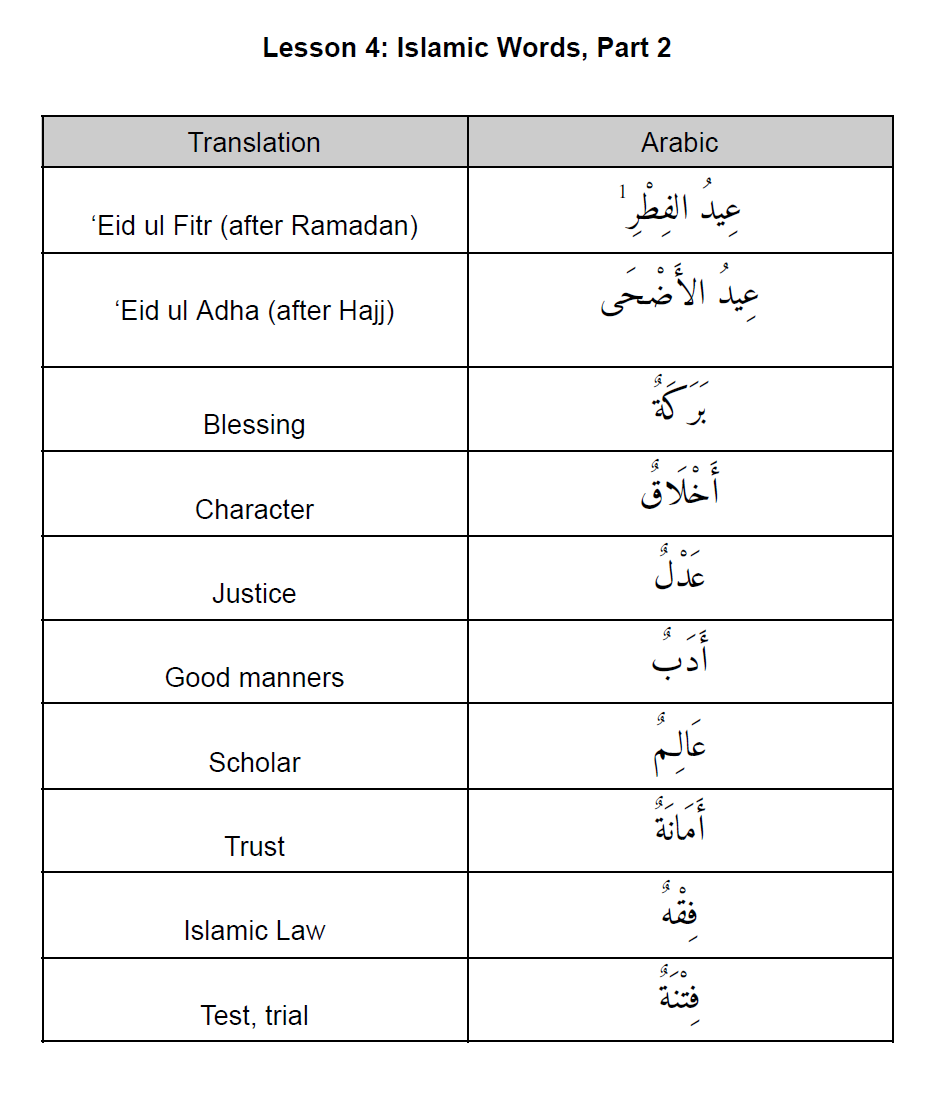
Reading: Review of two dammas, and then introduce two fathas and two kasrahs:
Lesson 4: ALL Three Types of Tanwin
You've already met tanwin damma — that double-vowel mark that adds an "n" sound at the end of a word. Now let's meet its two siblings! By the end of this lesson, you'll know all three types of tanwin and how to use them.
Quick Review: What is Tanwin?
Tanwin (تَنْوِين) means "adding an n." It's a special mark at the end of a word that adds an "n" sound to the vowel.
The simple rule: Tanwin = harakat doubled = vowel + "n"
Just like the regular harakat (fatha, kasra, damma) come in three flavors, tanwin comes in three flavors too — one for each vowel sound!
Meet the Three Tanwin Twins
1. Tanwin Fath ( ـً ) — the "an" sound
This is fatha's twin. Instead of one little dash on top, you draw two dashes side by side, slanting like little raindrops: ـً
How to say it: Add an "an" sound to the letter.
بَ (ba) → بً (ban)
كَ (ka) → كً (kan)
Special rule — the silent alif: Tanwin fath almost always needs an alif (ا) at the end of the word to "hold" it. The alif is silent — it doesn't make any sound. It's just there as a little chair for the tanwin to sit on!
So you'll usually see it written as ـًا at the end of a word.
Examples:
كِتَابًا (kitāban) — "a book"
شُكْرًا (shukran) — "thank you!"
أَهْلًا (ahlan) — "welcome!"
Two exceptions where tanwin fath does NOT need an alif:
Words ending in ة (ta marbuta): شَهَادَةً (shahādatan)
Words ending in ء (hamza on its own): مَاءً (mā'an) — "water"
2. Tanwin Kasr ( ـٍ ) — the "in" sound
This is kasra's twin. Instead of one little dash below, you draw two dashes side by side underneath the letter: ـٍ
How to say it: Add an "in" sound (like "een" in "seen") to the letter.
بِ (bi) → بٍ (bin)
كِ (ki) → كٍ (kin)
No silent alif needed! Tanwin kasr just sits quietly under the last letter all by itself.
Examples:
كِتَابٍ (kitābin) — "of a book"
بَيْتٍ (baytin) — "of a house"
وَلَدٍ (waladin) — "of a boy"
3. Tanwin Damm ( ـٌ ) — the "un" sound
This is damma's twin — the one you already know! It looks like a damma with an extra little hook or curl added on: ـٌ
How to say it: Add an "un" sound (like "oon" in "moon") to the letter.
بُ (bu) → بٌ (bun)
كُ (ku) → كٌ (kun)
No silent alif needed! Tanwin damm sits on top of the last letter by itself.
Examples:
كِتَابٌ (kitābun) — "a book"
بَيْتٌ (baytun) — "a house"
وَلَدٌ (waladun) — "a boy"
See Them Side by Side
Let's take one word — كِتَاب (kitāb, "book") — and watch all three tanwins do their job:
FormSoundMeaningكِتَابٌkitābun"a book" (subject)كِتَابًاkitāban"a book" (object)كِتَابٍkitābin"of a book"
The word stays the same — only the last sound changes depending on its job in the sentence!
Easy Way to Remember
MarkLooks LikeSoundNeeds Alif?Tanwin Fath ـًtwo dashes on top"an"Yes (usually!)Tanwin Kasr ـٍtwo dashes below"in"NoTanwin Damm ـٌdamma with extra curl on top"un"No
Kid-friendly memory trick:
Top + an alif chair → "an" (fath)
Bottom, no chair → "in" (kasr)
Top, no chair → "un" (damm)
When Do We Use Tanwin?
In English, we say "a book" or "an apple" to talk about something general. We say "the book" to talk about something specific.
Arabic does the same thing — but instead of putting "a" before the word, Arabic adds tanwin at the end of the word!
The book → ٱلْكِتَابُ (al-kitābu) — uses regular damma
A book → كِتَابٌ (kitābun) — uses tanwin damm
The little "n" sound at the end is like Arabic's secret way of saying "this is just any one — not a specific one!"
A helpful pattern to notice: When you see ٱلْ (al-) at the beginning of a word, you usually will NOT see tanwin at the end. They don't show up together — it's one or the other!
Which Tanwin Goes Where?
This depends on the word's job in the sentence — something called grammatical case in Arabic. Don't worry about memorizing this all at once! Here's the simple beginner version:
Tanwin Damm (un) — for the subject (the doer) Example: جَاءَ وَلَدٌ (jā'a waladun) — "A boy came" (the boy is doing the action)
Tanwin Fath (an) — for the object (the receiver) Example: رَأَيْتُ وَلَدًا (ra'aytu waladan) — "I saw a boy" (the boy received the action)
Tanwin Kasr (in) — after prepositions like "of," "in," "from," "with" Example: فِي بَيْتٍ (fī baytin) — "in a house"
For now, just focus on recognizing the three tanwins and reading them correctly. The grammar rules will come naturally with practice!
Practice: Read These Out Loud
Try saying each word with the correct tanwin sound:
Tanwin Damm (un):
بَيْتٌ (bayt-un) — a house
قَلَمٌ (qalam-un) — a pen
وَلَدٌ (walad-un) — a boy
Tanwin Fath (an):
بَيْتًا (bayt-an) — a house
قَلَمًا (qalam-an) — a pen
شُكْرًا (shukr-an) — thanks!
Tanwin Kasr (in):
بَيْتٍ (bayt-in) — of a house
قَلَمٍ (qalam-in) — of a pen
وَلَدٍ (walad-in) — of a boy
Notice how the word itself stays the same — only the ending sound changes!
Writing Tips
Write the word first, then the tanwin last. Just like with regular harakat, finish all your letters and dots before adding the tanwin marks.
Make the two dashes lean! For tanwin fath ( ـً ) and tanwin kasr ( ـٍ ), the two dashes should slant like little raindrops, not stand straight up. They look like sloping lines, not vertical lines.
Don't forget the silent alif for tanwin fath! When you write كِتَابًا, the final ا doesn't make any sound — but you still need to write it. It's the chair for the tanwin to sit on.
Keep the marks small and tidy. Tanwin should be clearly above or below the letter, but not floating too far away.
A Fun Game to Try
Look at any Arabic text — a Quran page, a children's book, or a sign — and play "Spot the Tanwin!"
Find a word ending in two dashes on top → that's tanwin fath ("an")
Find a word ending in two dashes below → that's tanwin kasr ("in")
Find a word ending in a damma with a curl → that's tanwin damm ("un")
Every time you find one, say the word out loud with its proper ending. Soon your eyes will spot tanwin automatically!
Writing:
Write out the words below, but also switch them to two fathas and two kasras
For two fathahs, introduce topic about addition of the alif, except for (ة).
Activity: how to convert two dammas to two fathas and two kasrahs:
Lesson 4 Words: Meet All Three Tanwin Endings!
Remember our three tanwin friends from last lesson? Let's see how the words we already know change when they wear each tanwin "outfit"!
The cool thing is — the word itself doesn't really change. Only the very last sound changes, depending on what job the word is doing in the sentence. It's like how you might wear different shoes for different activities — but you're still you!
The Three Tanwin Outfits
Before we dive in, let's remember what each tanwin sounds like:
Tanwin Damm ( ـٌ ) → "un" sound (think: "moon")
Tanwin Fath ( ـً ) → "an" sound (think: "fan")
Tanwin Kasr ( ـٍ ) → "in" sound (think: "seen")
Each one has a job:
"un" is for the doer (the one doing the action)
"an" is for the receiver (the one getting the action)
"in" comes after little words like "in," "of," "from"
The Big Chart (PRACTICE READING!)
Word MeansEnds in "un" (doer)Ends in "an" (receiver)Ends in "in" (after "in/of/from")Testimonyشَهَادَةٌ (shahādat-un)شَهَادَةً (shahādat-an)شَهَادَةٍ (shahādat-in)Prayerصَلَاةٌ (salāt-un)صَلَاةً (salāt-an)صَلَاةٍ (salāt-in)Fastingصَوْمٌ (sawm-un)صَوْمًا (sawm-an)صَوْمٍ (sawm-in)Ramadanرَمَضَانُ (ramaḍān-u) رَمَضَانَ (ramaḍān-a) رَمَضَانَ (ramaḍān-a) Charityزَكَاةٌ (zakāt-un)زَكَاةً (zakāt-an)زَكَاةٍ (zakāt-in)Pilgrimageحَجٌّ (ḥajj-un)حَجًّا (ḥajj-an)حَجٍّ (ḥajj-in)Tarawihتَرَاوِيحُ (tarāwīḥ-u) تَرَاوِيحَ (tarāwīḥ-a) تَرَاوِيحَ (tarāwīḥ-a) Breaking fastإِفْطَارٌ (ifṭār-un)إِفْطَارًا (ifṭār-an)إِفْطَارٍ (ifṭār-in)Pre-fasting mealسُحُورٌ (suḥūr-un)سُحُورًا (suḥūr-an)سُحُورٍ (suḥūr-in)Worshipعِبَادَةٌ (ʿibādat-un)عِبَادَةً (ʿibādat-an)عِبَادَةٍ (ʿibādat-in)
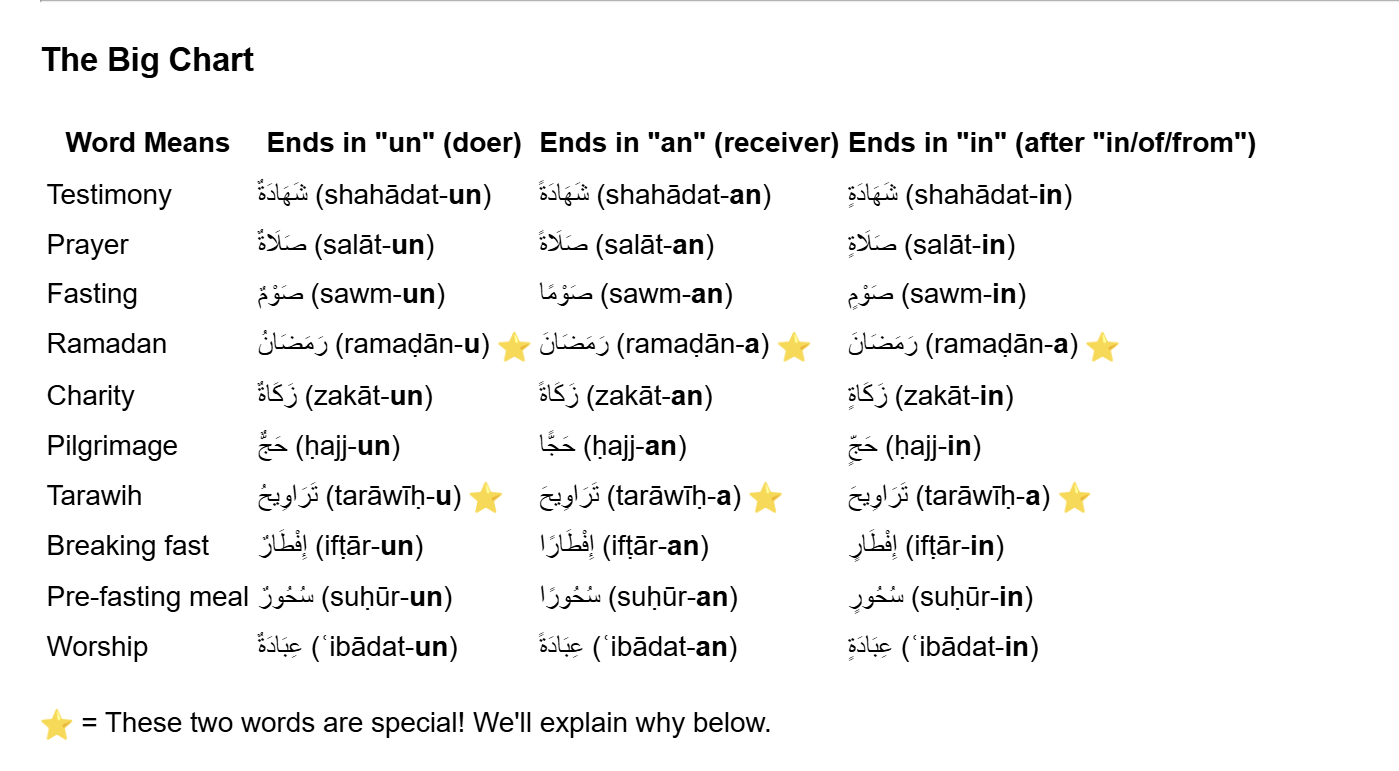
Still introduce starred words, but don’t explain why
Two Cool Things to Notice
Cool Thing #1: The Sneaky Silent Alif
Look at these "an" forms carefully:
صَوْمًا — has an alif at the end (silent!)
إِفْطَارًا — has an alif at the end (silent!)
سُحُورًا — has an alif at the end (silent!)
But look at these:
شَهَادَةً — NO extra alif
صَلَاةً — NO extra alif
زَكَاةً — NO extra alif
عِبَادَةً — NO extra alif
Why the difference? Because words ending in ة (ta marbuta) don't need a silent alif — the tanwin fath sits right on top of the ة. The ة is already a "chair" for the tanwin!
Easy rule to remember:
If the word ends in ة, no silent alif needed. If the word ends in any other letter, add a silent alif (ا) when you write tanwin fath.
Cool Thing #2: The "Stuck" ة Becomes a Real "T"
When you say these words alone, the ة sounds like a soft "ah":
شَهَادَة → "shahāda"
صَلَاة → "salā" (with a soft 'ah')
But when tanwin is added, the ة wakes up and becomes a real "t" sound:
شَهَادَةٌ → "shahādat-un"
صَلَاةٌ → "salāt-un"
It's like ة is shy on its own, but speaks up when tanwin gives it confidence!
Why Are Ramadan and Tarawih Special?
Some words in Arabic are part of a special "VIP club" — they don't follow the regular tanwin rules. Two of our words are in this club: رَمَضَان and تَرَاوِيح.
These words have two special rules:
Rule 1: They never wear tanwin. Even when other words would have tanwin, these words just use a single harakat — no doubling, no "n" sound at the end.
Wrong: رَمَضَانٌ
✓ Right: رَمَضَانُ (just one damma — no tanwin!)
Rule 2: For the "in" job, they use fatha instead of kasra. Normally we'd expect the "in" form to use kasra ( ـِ ). But these special words use fatha ( ـَ ) instead!
✓ فِي رَمَضَانَ (fī ramaḍāna) — "in Ramadan"
✓ فِي تَرَاوِيحَ (fī tarāwīḥa) — "in Tarawih"
Why these words? Arabic puts certain types of words in this VIP club:
Names of months (like Ramadan!)
Names of people that come from other languages (like Ibrahim, Yusuf)
Female names
Names ending in -ān (like Ramadan, ʿUthmān)
Special plural patterns (like Tarawih, which is a plural)
You don't need to memorize all this right now! Just know that Ramadan and Tarawih are special — they don't take tanwin, and they use fatha instead of kasra after "in/of/from" words.
Let's See Tanwin in Action!
Here are some simple example sentences to help you hear how tanwin works:
Tanwin Damm — when the word is the doer:
جَاءَتْ صَلَاةٌ (jā'at salātun) — "A prayer came." (the prayer is the doer)
Tanwin Fath — when the word is getting the action:
يُصَلِّي صَلَاةً (yuṣallī salātan) — "He prays a prayer." (the prayer is being prayed)
يَصُومُ صَوْمًا (yaṣūmu sawman) — "He fasts a fast." (the fast is being fasted)
Tanwin Kasr — when there's a little word like "in" or "from" before it:
فِي صَلَاةٍ (fī salātin) — "in a prayer"
مِنْ زَكَاةٍ (min zakātin) — "from a charity"
بَعْدَ سُحُورٍ (baʿda suḥūrin) — "after a pre-fasting meal"
Try This: The Three-Outfit Game!
Pick one word from the chart each day. Write it three times — once in each tanwin outfit — and say each one out loud:
Day 1: صَلَاة (Prayer)
صَلَاةٌ → "salāt-un" (the doer)
صَلَاةً → "salāt-an" (the receiver)
صَلَاةٍ → "salāt-in" (after "in/of/from")
Day 2: صَوْم (Fasting)
صَوْمٌ → "sawm-un"
صَوْمًا → "sawm-an" (don't forget the silent alif!)
صَوْمٍ → "sawm-in"
After a few days of practice, your ears will start to recognize tanwin everywhere — in du'as, in Quran recitation, and in everyday Arabic!
Quick Writing Tips
Write the word first, then the dots, then the tanwin last. Three steps, in order!
Watch out for the silent alif! When you write tanwin fath on a word that doesn't end in ة, remember to add the alif (ا) at the end. It's silent — but it has to be there.
Make the marks small and tidy. The two little dashes of tanwin fath and tanwin kasr should slant like raindrops, not stand straight up.
Don't mix up ـٌ and ـُ! Tanwin damm has an extra little curl — regular damma is just one curl. Look carefully!