
READING
Introduce Nouns, which have Tanwin (double damma)
“n” sound
indicates a general word
Tanwin Damma for Kids
What is Tanwin Damma?
You already know damma ( ـُ ) — that little curl on top of a letter that makes a "u" sound (like "oo" in "moon").
Tanwin damma ( ـٌ ) is just damma's bigger sibling! It's a damma with a little extra hook or tail added to it. When you see it, you say the "u" sound plus an "n" at the end.
So instead of just "u", you say "un"!
What Does It Look Like?
Regular damma looks like a tiny curl — kind of like a small comma sitting on top of a letter: ـُ
Tanwin damma looks like a damma with an extra little curl or hook added on: ـٌ
Some kids think it looks like:
A damma wearing a tail
A tiny "9" with an extra swoosh
Two little curls hugging each other
How to Say It
Whenever you see tanwin damma at the end of a word, add an "un" sound.
Examples:
كِتَابٌ = "kitābun" (a book)
وَلَدٌ = "waladun" (a boy)
بَيْتٌ = "baytun" (a house)
رَجُلٌ = "rajulun" (a man)
When Do We Use It?
Tanwin damma usually appears at the end of a word when we're talking about something general — like saying "a book" instead of "the book" in English.
Think of it this way:
"The book" in Arabic → ٱلْكِتَابُ (al-kitābu) — uses regular damma
"A book" in Arabic → كِتَابٌ (kitābun) — uses tanwin damma
The "n" sound at the end is like a tiny clue that tells you "this is just any book, not a specific one!"
Practice Tip
When you write tanwin damma, draw the regular damma first, then add the little extra curl or hook. Keep both parts small and tidy — they should sit close together on top of the letter, like best friends holding hands!
Try saying these out loud:
"Bay-tun" 🏠
"Wa-la-dun" 👦
"Ki-tā-bun" 📖
Can you hear that little "n" sound at the end? That's the tanwin saying hello!
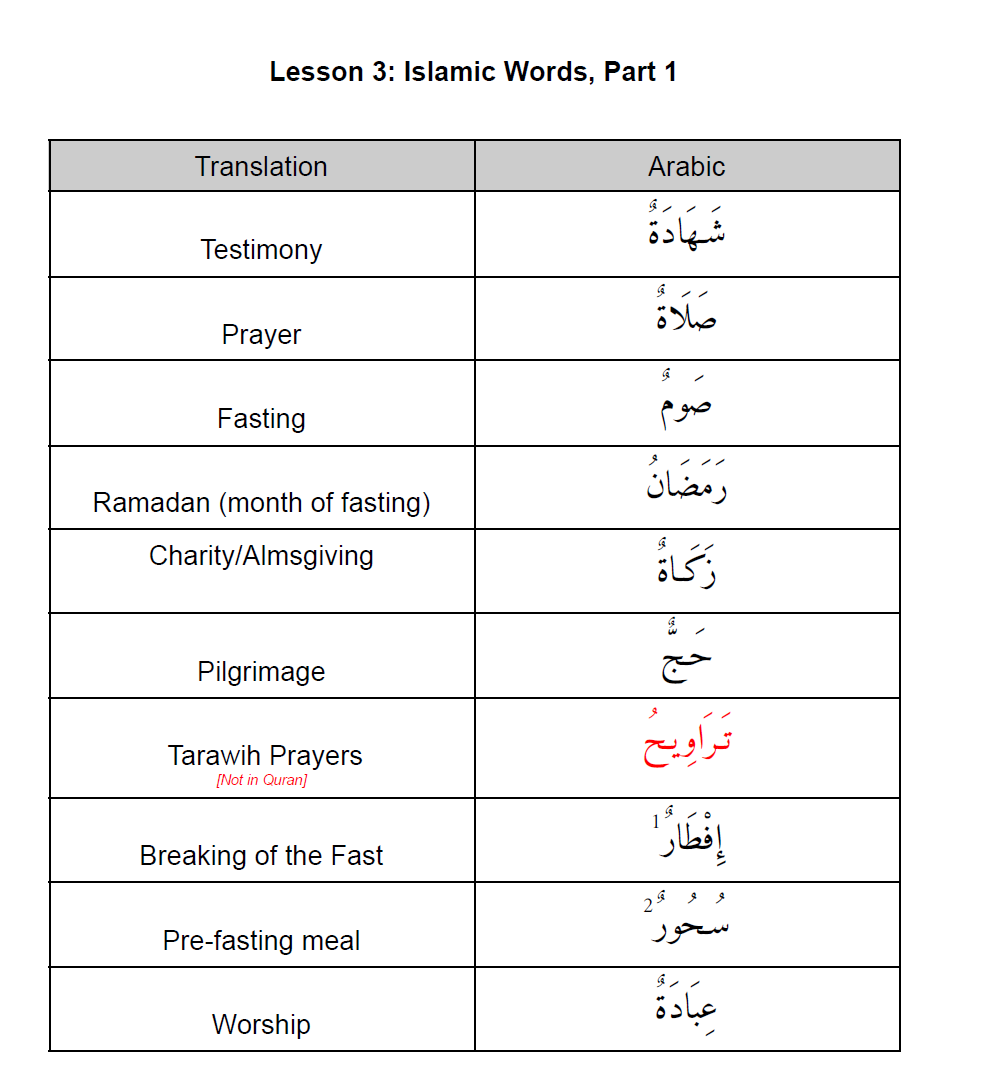
Writing:
Lesson 3: Writing Islamic Words — A Beginner's Guide
These ten important words appear throughout Islamic learning. Many of them describe the Five Pillars of Islam! Let's learn how to write each one carefully.
Quick Refresher
Remember: Arabic is written right to left. Most letters connect, but a few are "loners" (ا، د، ذ، ر، ز، و) — they don't connect to the letter after them, so you have to lift your pen.
You'll also see a special letter in many of these words: ة (ta marbuta), which we'll meet below!
Meet the Ta Marbuta (ة)
Several words on this list end with a special letter called ta marbuta — literally "tied ta." It looks like a round ه (ha) but with two dots on top like a regular ت (ta).
How to write it: Draw a small circle (like the letter ه), then add two dots above it.
How to say it: Usually pronounced as a soft "-ah" sound. The "t" sound only shows up when the word is connected to other words in a sentence.
You'll see ta marbuta in: شَهَادَة، صَلَاة، زَكَاة، عِبَادَة
The Ten Words
1. شَهَادَةٌ (shahādatun) — "Testimony"
Start with ش (shin) — three little teeth with three dots on top arranged like a triangle. Connect to ه (ha) — in the middle of a word, it has a special figure-eight or knotted shape. Connect to ا (alif) — a simple straight vertical line. Lift your pen! (Alif is a loner.) Then د (dal) — a check-mark shape. Lift your pen again! Finally ة (ta marbuta) — the round circle with two dots.
Harakat: fatha on ش, fatha on ه, fatha on د, tanwin damma on ة (the "-tun" sound).
Memory tip: This is the shahāda — the testimony of faith every Muslim says!
2. صَلَاةٌ (salātun) — "Prayer"
Start with ص (sad) — an oval shape followed by a small tooth, no dots. Connect to ل (lam) — the tall candy-cane line. Connect to ا (alif) — straight vertical line. Lift your pen! Then ة (ta marbuta).
Harakat: fatha on ص, fatha on ل, tanwin damma on ة.
Watch out: ص is a "fat" letter — give its oval body plenty of room!
3. صَوْمٌ (sawmun) — "Fasting"
Start with ص (sad) — that oval with a tooth. Connect to و (waw) — looks like a little number "9" or a circle with a tail dipping below the line. Lift your pen! (Waw is a loner.) Then م (mim) — a small round circle with a tail going down.
Harakat: fatha on ص, sukun (a tiny circle ـْ meaning "no vowel") on و, tanwin damma on م.
New friend: The sukun ( ـْ ) is a little circle that means "stop here, no vowel sound." It tells you to pronounce just the consonant.
4. رَمَضَانُ (ramaḍānu) — "Ramadan"
Start with ر (ra) — the swooping curve below the line. Lift your pen! Start م (mim) — small circle with a tail. Connect to ض (dad) — oval with a tooth and one dot on top. Connect to ا (alif) — straight line. Lift your pen! Finally ن (nun) — a deep round bowl with one dot on top.
Harakat: fatha on ر, fatha on م, fatha on ض, damma on ن.
Notice: This word doesn't take tanwin because Ramadan is a name — names of months and people often skip tanwin!
5. زَكَاةٌ (zakātun) — "Charity / Almsgiving"
Start with ز (zay) — the swooping curve with one dot on top. Lift your pen! Start ك (kaf) — backwards-L shape with a little squiggle inside. Connect to ا (alif) — straight line. Lift your pen! Then ة (ta marbuta).
Harakat: fatha on ز, fatha on ك, tanwin damma on ة.
Don't confuse: ز (zay) and ر (ra) look almost identical — the only difference is that ز has a dot on top!
6. حَجٌّ (ḥajjun) — "Pilgrimage"
Start with ح (ha) — a little smile or curve, no dots. Connect to ج (jim) — same curve shape but with one dot inside or below.
Harakat: fatha on ح, shadda on ج (a tiny "w" shape ـّ meaning "double this letter"), tanwin damma on top.
New friend: The shadda ( ـّ ) looks like a little "w" or rounded mountain. It means the letter is doubled — so you press on it twice when you say it: "Haj-j!"
Tricky bit: ح and ج look like twins! Ha (ح) has no dot, jim (ج) has one dot. Only two letters in this whole word — the shortest on our list!
7. تَرَاوِيحُ (tarāwīḥu) — "Tarawih Prayers"
Start with ت (ta) — a small bowl with two dots on top. Connect to ر (ra) — swooping curve. Lift your pen! Start ا (alif) — straight line. Lift your pen! Start و (waw) — the little "9" shape. Lift your pen! Start ي (ya) — but in the middle of a word, it has a tooth shape with two dots underneath. Connect to ح (ha) — but at the end of a word, ha takes its full smile shape.
Harakat: fatha on ت, fatha on ر, kasra on و, damma on ح.
Lots of pen-lifting! This word has three loner letters (ا، و، ر) — your hand will be busy!
8. إِفْطَارٌ (ifṭārun) — "Breaking the Fast"
Start with ا (alif) — straight vertical line — with a small hamza ( ء ) sitting underneath it, which looks like a tiny "2." Lift your pen! Start ف (fa) — small loop with one dot on top. Connect to ط (ṭa) — an oval body with a tall vertical line standing up out of it, no dots. Connect to ا (alif). Lift your pen! Then ر (ra) — swooping curve.
Harakat: kasra below the hamza, sukun on ف, fatha on ط, tanwin damma on ر.
Special letter: ط (ṭa) is one of Arabic's "tall" letters — like a building with a flag pole!
9. سُحُورٌ (suḥūrun) — "Pre-fasting Meal"
Start with س (sin) — three little teeth followed by a bowl, no dots. Connect to ح (ha) — the little smile. Connect to و(waw) — the "9" shape. Lift your pen! Then ر (ra) — swooping curve.
Harakat: damma on س, damma on ح, tanwin damma on ر.
Listen for the rhythm: "Su-ḥū-run" — lots of "u" sounds in this word, just like the harakat tell you!
10. عِبَادَةٌ (ʿibādatun) — "Worship"
Start with ع (ayn) — that special "eye" or curl shape. Connect to ب (ba) — small bowl with one dot underneath. Connect to ا (alif) — straight line. Lift your pen! Start د (dal) — check-mark shape. Lift your pen again! Finally ة (ta marbuta).
Harakat: kasra below ع, fatha on ب, fatha on د, tanwin damma on ة.
Big idea: This word means "worship" — the purpose behind all the other words on this list!
Three New Friends to Remember
You met three special marks in this lesson:
Sukun ( ـْ ) — a tiny circle that means "no vowel, just the consonant." Found in صَوْمٌ and إِفْطَارٌ.
Shadda ( ـّ ) — a little "w" or mountain shape that means "double the letter." Found in حَجٌّ.
Ta marbuta ( ة ) — the "tied ta" — a round letter with two dots, usually pronounced as a soft "-ah." Found in many feminine nouns.
Practice Tips
Write the skeleton first, then add the dots, then add the harakat last. This three-step rhythm keeps your writing neat: letters → dots → vowel marks.
Watch the loners! Six letters never connect forward: ا، د، ذ، ر، ز، و. Every time you write one, expect to lift your pen.
Don't confuse the look-alikes:
ر (ra) vs. ز (zay) — only difference is the dot on top of ز
ح (ha) vs. ج (jim) vs. خ (kha) — same shape, but ح has no dot, ج has a dot below, خ has a dot above
ب (ba) vs. ت (ta) vs. ث (tha) — same bowl shape, but with 1, 2, or 3 dots
Say it as you write it. Sounding out each letter helps your brain connect the shape to the sound: "Sa-lā-tun!" "Ṣaw-mun!"
For older learners: Notice that most "feminine" Islamic concepts on this list end in ة (ta marbuta) — shahāda, salāt, zakāt, ʿibāda. This is a grammatical pattern you'll see everywhere in Arabic!