
READING:
Verbs with fatha-kasrah-fatha past tense (eg لعِب - سمِع etc)
find 10 verbs
Verbs with Kasra in the Middle (فَعِلَ)
These often describe states, feelings, or conditions.
1. عَلِمَ (ʿalima) — "he knew" Extremely common in the Quran. Root of ʿilm (knowledge). Example: wa-llāhu yaʿlamu... ("And Allah knows...")
2. سَمِعَ (samiʿa) — "he heard" Root of samīʿ (the All-Hearing), one of Allah's names. Example: qad samiʿa llāhu... ("Allah has indeed heard...") — Al-Mujādila 58:1.
3. شَهِدَ (shahida) — "he witnessed / testified" Root of shahāda (testimony of faith). Example: shahida llāhu... ("Allah bears witness...") — Āl ʿImrān 3:18.
4. رَكِبَ (rakiba) — "he rode / mounted" Used for boarding ships or riding animals. Example: Found in the story of Nuh and the ark.
5. حَسِبَ (ḥasiba) — "he thought / reckoned" Often used for assumptions or calculations. Example: a-ḥasiba n-nāsu... ("Do people think...?") — Al-ʿAnkabūt 29:2.
6. رَضِيَ (raḍiya) — "he was pleased / accepted" Root of riḍwān (good pleasure of Allah). Example: raḍiya llāhu ʿanhum ("Allah is pleased with them") — Al-Mā'ida 5:119.
7. خَسِرَ (khasira) — "he lost" Root of khusrān (loss). Example: khasira d-dunyā wa-l-ākhirah ("he loses this world and the hereafter") — Al-Ḥajj 22:11.
8. وَرِثَ (waritha) — "he inherited" Root of mīrāth (inheritance). Example: wa-waritha sulaymānu dāwūd ("And Solomon inherited David") — An-Naml 27:16.
Verbs with Damma in the Middle (فَعُلَ)
This pattern is rarer and usually describes inherent, permanent qualities.
9. كَبُرَ (kabura) — "he/it became great / was great" Used for things that are immense or grave. Example: kaburat kalimatan... ("Grave is the word...") — Al-Kahf 18:5.
10. حَسُنَ (ḥasuna) — "he/it was/became good / beautiful" Root of ḥasan (good) and iḥsān (excellence). Example: wa-ḥasunat murtafaqā ("and excellent is the resting place") — Al-Kahf 18:31.
The above are additional verbs just to practice reading. They are simple Quranic verbs and ONLY thoe with fathah are included to keep it easy.
Meanings for these are helpful but NOT required to learn. Focus is on reading them, NOT meaning.
Just start off with these. Basic only.
NOT focusing on conjugations. Only هو form. Just practice reading them. And ONLY on past-tense. And ONLY fathah-only.
Writing:
Writing Arabic Verbs with Kasra and Damma: A Beginner's Guide
These ten verbs use the same three-letter pattern as before, but with different vowel marks in the middle. Let's review the harakat first, then learn each verb!
Meet the Harakat (Vowel Marks)
You already know fatha ( ـَ ) — the little dash above a letter that makes an "a" sound.
Now meet two new friends:
Kasra ( ـِ ) — a little dash below a letter that makes an "i" sound (like "ee" in "see"). Think of it as fatha's twin who fell down!
Damma ( ـُ ) — a tiny curl above a letter that looks like a small comma or a baby waw (و). It makes a "u" sound (like "oo" in "moon").
Easy way to remember:
Fatha = dash on top → "a"
Kasra = dash on bottom → "i"
Damma = little curl on top → "u"
In all the verbs below, you'll write fatha on the first letter, kasra or damma on the middle letter, and fatha on the last letter.
Verbs with Kasra in the Middle
1. عَلِمَ (ʿalima) — "he knew"
Start on the right with ع (ayn) — that special "eye" or curl shape, no dots. Connect to ل (lam) — the tall candy-cane line. Connect to م (mim) — a tiny round circle with a little tail going down.
Harakat: fatha on ع, kasra below ل, fatha on م.
Memory tip: This is the verb used for "knowing" — and Allah is al-ʿAlīm, the All-Knowing.
2. سَمِعَ (samiʿa) — "he heard"
Start with س (sin) — three little teeth followed by a bowl, no dots. Connect to م (mim) — small circle with a tail. Connect to ع (ayn) — but careful! When ʿayn comes at the end of a word, it has a different shape: it looks like a little open mouth or a curve.
Harakat: fatha on س, kasra below م, fatha on ع.
Fun fact: Arabic letters change shape depending on where they sit in the word — beginning, middle, or end. ع is one of the trickiest!
3. شَهِدَ (shahida) — "he witnessed"
Start with ش (shin) — three little teeth with three dots on top (like a tiny triangle of dots). Connect to ه (ha) — when it's in the middle of a word, it looks like a small figure-eight or two little loops stacked. Lift your pen! Then د (dal) — a shape like a check mark, no dots.
Harakat: fatha on ش, kasra below ه, fatha on د.
Watch out: د is a "loner" letter — nothing connects after it. And ه has four different shapes depending on its position!
4. رَكِبَ (rakiba) — "he rode"
Start with ر (ra) — the swooping curve below the line. Lift your pen! Start ك (kaf) — but in the middle of a word, kaf looks different: like a tall hook or a little flag. Connect to ب (ba) — a small bowl with one dot underneath.
Harakat: fatha on ر, kasra below ك, fatha on ب.
Remember: ر is a loner, so you lift your pen after it.
5. حَسِبَ (ḥasiba) — "he thought"
Start with ح (ha) — the little smile or curve, no dots. Connect to س (sin) — three teeth and a bowl. Connect to ب (ba) — bowl with one dot underneath.
Harakat: fatha on ح, kasra below س, fatha on ب.
6. رَضِيَ (raḍiya) — "he was pleased"
Start with ر (ra) — swooping curve. Lift your pen! Start ض (dad) — an oval with a tooth and one dot on top. Connect to ي (ya) — a deep curve like a smile, with two dots underneath.
Harakat: fatha on ر, kasra below ض, fatha on ي.
Tricky bit: The final ي here has the shape of a deep bowl that dips below the line.
7. خَسِرَ (khasira) — "he lost"
Start with خ (kha) — teardrop shape with one dot on top. Connect to س (sin) — three teeth and a bowl. Connect to ر (ra) — the swooping curve.
Harakat: fatha on خ, kasra below س, fatha on ر.
8. وَرِثَ (waritha) — "he inherited"
Start with و (waw) — looks like a little number "9" or a circle with a tail. Lift your pen! Start ر (ra) — the swooping curve. Lift your pen again! Start ث (tha) — a small bowl with three dots on top (like a triangle).
Harakat: fatha on و, kasra below ر, fatha on ث.
Watch out: Both و and ر are loners — you'll lift your pen twice in this word! It looks like three separate pieces.
Verbs with Damma in the Middle
9. كَبُرَ (kabura) — "he/it became great"
Start with ك (kaf) — backwards-L shape with a squiggle inside. Connect to ب (ba) — bowl with one dot underneath. Connect to ر (ra) — the swooping curve.
Harakat: fatha on ك, damma above ب (the little curl!), fatha on ر.
Memory tip: Allahu Akbar — "Allah is greatest" — comes from this same root!
10. حَسُنَ (ḥasuna) — "he/it was good"
Start with ح (ha) — little smile, no dots. Connect to س (sin) — three teeth and a bowl. Connect to ن (nun) — a deep round bowl with one dot on top.
Harakat: fatha on ح, damma above س (the little curl!), fatha on ن.
Memory tip: The name Hasan (a popular name meaning "good" or "handsome") comes from this verb!
Practice Tips for Young Students (for textbook call out box only)
When you're writing the harakat, finish writing the whole word first — letters and dots — before going back to add the vowel marks on top and bottom. This keeps your writing neat.
Make the damma small! It should look like a tiny curl, not a big circle. Some kids draw it like a number "9" without the line — just the loop.
Make the kasra clearly below the letter, with a little space. Don't let it touch the letter or it might look like a dot.
Practice saying the sounds as you write: "Ka-Bu-Ra!" "Sa-Mi-ʿa!" The rhythm helps you remember which vowel goes where.
A fun game: After writing each verb, point to the middle letter and ask yourself — "Is this an 'i' sound or a 'u' sound?" Then check the harakat to see if you got it right!
Would you like me to put all 20 verbs (from both lessons) onto a practice sheet you can print and trace?
Vocab:
They will learn the above vocab
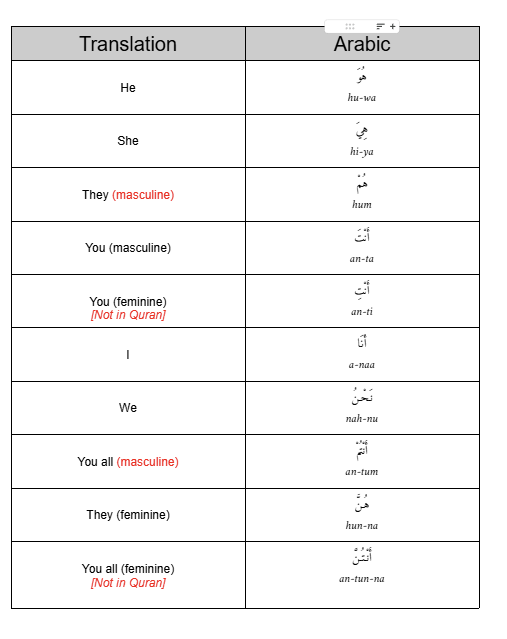
In this lesson, we will practice reading words with past-tense verbs that are in singular masculine form, given these are quite basic. The first letter will always be fathah, and the last letter will always be fathah (ــَـ). The middle letter can be a fathah (ــَـ) (as was covered in Lesson 1), or a kasrah (ــِـ), which we practice in this lesson.
The next lesson will practice simple past-tense verbs that have a dammah (ــُـ) in the middle letter.
Past tense Verbs with 2 Fata. (middle one kasra) (add more verbs to practice reading, preferably from 1A). note to students that they don’t need to learn the vocabulary, make meaning light gray

Read many verbs with karsa in middle to practice basic word reading. selective ones highlight meaning.